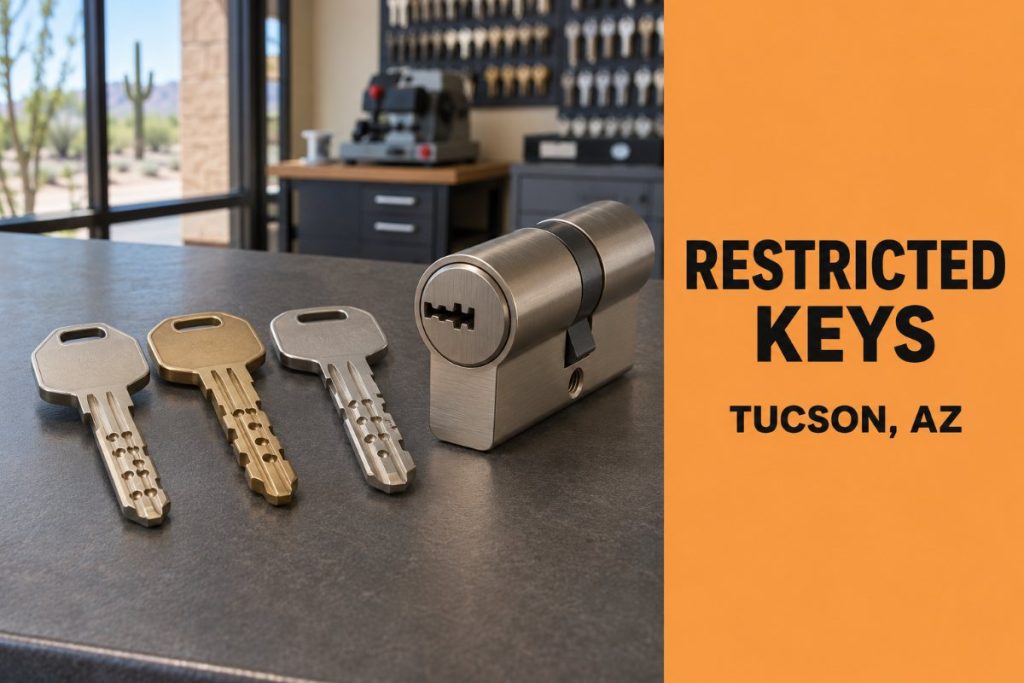
Quick answer: Restricted keys use a patented keyway that hardware stores and kiosks cannot copy. Only an authorized locksmith can cut duplicates, and only with the owner’s permission. CallOrange sets them up for Tucson businesses and homes. Call (520) 542-2797.
Every business owner has wondered how many copies of the store key are out there. A standard key can be copied at any hardware store or self-service kiosk in minutes, by anyone who holds it. Restricted keys close that gap. They use a keyway protected by patent and a blank that is only sold to authorized dealers, so copies are controlled by the owner. This guide explains how restricted keys work, six reasons businesses use them, what setup involves and how to manage them.
CallOrange Locksmith of Tucson installs restricted key systems for shops, offices, clinics and property managers across the city, including the University Area and Midtown.
How Restricted Keys Work
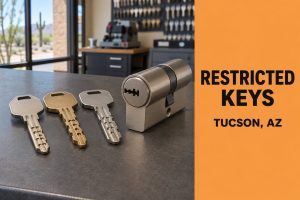
Restricted keys have a keyway shape that is legally protected, usually by a utility patent. Manufacturers only sell the blanks to locksmiths who sign an agreement and keep records. Each system has an authorization card or signature list; to get a duplicate, the authorized person must request it in writing or in person. Without that authorization, no legitimate locksmith can cut a copy, and kiosks cannot produce one at all because they do not have the blanks.
Many restricted keys are paired with high-security cylinders that also resist picking, bumping and drilling. Our page on high-security locks covers those features in more detail.
6 Essential Reasons Businesses Use Restricted Keys
1. Stop unauthorized copies
Employees, contractors and cleaners cannot make extra keys on their own. That alone solves a problem most owners did not know they had.
2. Know exactly how many keys exist
Every key is cut by the locksmith and recorded. With restricted keys, your key count stays accurate for years.
3. Fewer rekeys after turnover
When an employee leaves and returns their key, you can be confident no copies exist. That means fewer emergency rekeys.
4. Works with a master key system
Restricted keys can be built into a master key system, so owners carry one key and staff carry limited keys, all protected from copying.
5. Helps with insurance and compliance
Clinics, pharmacies and businesses that store records or controlled items often need documented key control. Restricted keys provide that paper trail.
6. Protects rental and multi-unit properties
Property managers use restricted keys on common doors, mail rooms and maintenance closets so tenants cannot copy access keys.
Want restricted keys for your business?
Tell us how many doors and keyholders you have. We quote the system before we come out.
Standard vs. Restricted Keys
| Feature | Standard key | Restricted key |
|---|---|---|
| Copied at hardware stores | Yes | No |
| Copied at kiosks | Yes | No |
| Owner authorization required | No | Yes |
| Key records kept | No | Yes |
What Setup Involves
We start by listing the doors and the people who need keys. Then we choose a restricted keyway and cylinders that fit your existing hardware where possible. We install or rekey the cylinders, cut the keys, and register you as the authorized owner with a signature card. From then on, duplicates are cut only at your request. Many businesses start with the front door, back door and office, then expand. The work is similar to a lock rekey visit, with the added registration step.
Managing Restricted Keys Day to Day
- Keep a key log. Number each key and record who holds it.
- Limit who can authorize copies. One or two people is ideal.
- Collect keys on the last day. Make key return part of every exit checklist.
- Report lost keys right away. We rekey only the affected cylinders.
Mistakes to Avoid
- Do not mix restricted and standard cylinders on critical doors. A standard back door undoes the control.
- Do not let the authorization card go missing. Keep it with business records.
- Do not assume patents last forever. Ask how long the keyway is protected.
- Do not hand out keys without logging them.
Restricted Keys for Homes
Homeowners also use restricted keys, especially landlords with casitas, families with many keyholders, and owners who had a bad experience with copied keys. If you have just moved, our guide on rekey after moving explains how to combine a rekey with restricted cylinders on the main doors.
Tucson Business Notes
Strip centers along Broadway, Speedway and Grant often have back doors facing alleys, and those doors see the most unauthorized use. Restaurants and retail shops with high staff turnover benefit most from restricted keys. Dust and heat are hard on all locks, so we recommend lubricating cylinders yearly with a dry product. For related hardware, see our articles on high security locks for commercial protection and changing locks for commercial properties.
For general workplace security planning, the CISA physical security page is a useful reference.
The Real Cost of Uncontrolled Copies
Most owners never find out how many copies of their store key exist until something goes wrong. A former employee lets themselves in after hours. Inventory disappears with no sign of forced entry. A cleaning company changes staff and nobody collects the old key. Each of these leads to the same expensive fix: rekeying every lock in the building, often on short notice. With patented keys that only the locksmith can cut, the question of how many copies exist always has a clear answer.
There is also a quieter benefit. When employees know their key cannot be duplicated, they take more care with it. Keys are returned at the end of a job more reliably, and lost keys are reported faster because staff know they cannot replace them quietly.
Choosing the Right System
Brands such as Medeco, Mul-T-Lock and ASSA offer patented keyways at different levels of protection. Some systems focus mainly on key control, while others add pick and drill resistance. The right choice depends on what you are protecting, how many doors are involved and your budget. A small office with three doors has different needs than a clinic with a medication room or a property with dozens of units. We walk through those details and recommend the simplest option that gives you the control you need.
We also consider how long the patent on a keyway lasts. A patent typically protects the design for many years, but not forever. When a keyway approaches the end of its protection, manufacturers usually offer a newer version, and we can plan an upgrade path so your control does not lapse.
Step-by-Step: Your First Week With the New System
- Day one: cylinders installed, keys cut and numbered, authorization card signed.
- Day two: hand out keys and record each holder in the log.
- Day three: collect and destroy all old keys from the previous locks.
- End of week: confirm every door works smoothly and everyone has what they need.
After that first week, the system mostly runs itself. Copies are requested through the authorized person, cut by us and logged. When someone leaves, their key comes back and the log is updated. If a key is lost, we rekey only the doors it opened.
Questions to Ask Before You Commit
- How many doors need protection now, and how many might be added later?
- Who should be allowed to order copies?
- Do any doors need extra pick or drill resistance?
- Can the new cylinders fit the existing hardware?
- How will keys be logged and collected?
Answering these up front keeps the setup simple and makes the quote accurate from the start.
A Simple Example
Picture a small clinic near the university with a front entrance, a back door to the alley, a records room, a medication closet and two exam room suites. Before the change, eight staff members carried the same front and back door key, and nobody knew how many copies had been made over the years. After the upgrade, the owner carries one master, two managers carry keys to every room except the medication closet, nurses carry a key to the closet and exam rooms, and front desk staff open only the entrance. Every key is numbered and logged, and copies are only cut when the owner signs for them. When a front desk employee leaves, one key comes back and nothing else needs to change.
That kind of structure takes a single visit to set up and saves many emergency calls in the years that follow.
Where We Install Restricted Keys
We serve Tucson from 2201 N Camino Principal, Suite #109, including the University Area, Midtown, East Tucson, the Catalina Foothills and Tanque Verde. We are open daily from 6 AM to 11 PM and can schedule work outside business hours.
Frequently Asked Questions About Restricted Keys
What are restricted keys?
Keys with a patented keyway that only authorized locksmiths can duplicate, with the owner’s permission.
Can restricted keys be copied at a hardware store?
No. Hardware stores and kiosks do not have the blanks.
Who can order copies?
Only the people listed on your authorization card.
Can I use my existing locks?
Sometimes we can fit restricted cylinders into your current hardware.
Do restricted keys work with a master key system?
Yes. They are often combined.
Are restricted keys the same as high-security locks?
Not always. Many high-security locks use restricted keys, but key control and pick resistance are separate features.
What if an employee loses one?
We rekey only the cylinders that key opened.
Are they only for businesses?
No. Homeowners and landlords use them too.
How much do restricted keys cost?
It depends on the cylinders and number of keys. Call (520) 542-2797 and we quote it first.
What hours are you open?
Every day from 6 AM to 11 PM in Tucson.