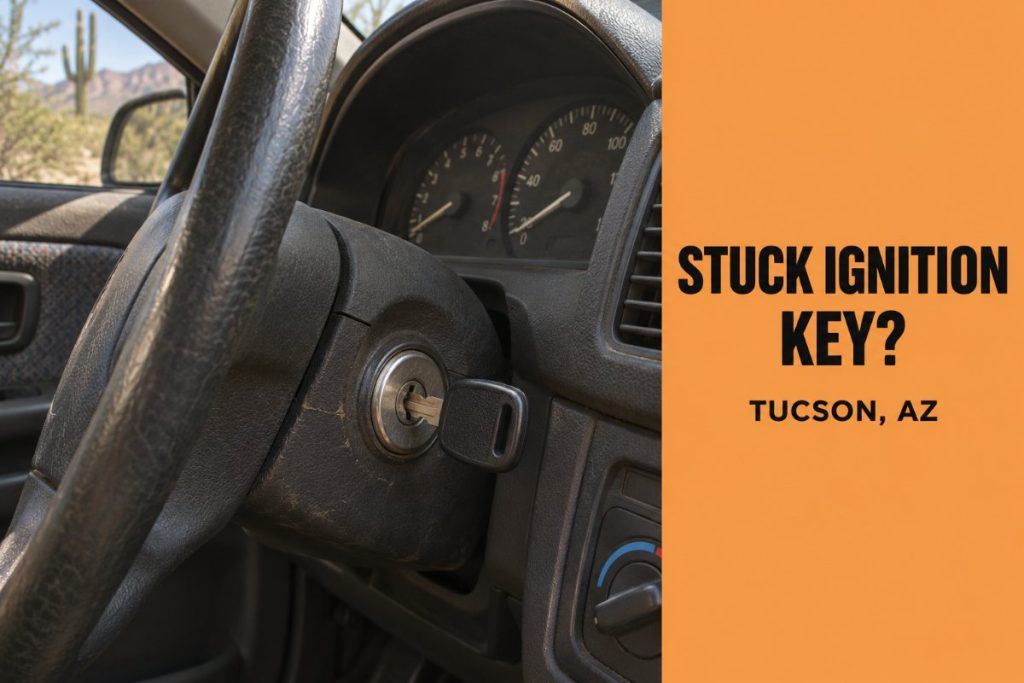
Quick answer: A stuck ignition key is usually caused by the steering wheel lock, the shifter not fully in Park, a dead battery or a worn key. Try the five fixes below before forcing anything; if the key still will not move, CallOrange repairs the ignition at your car. Call (520) 542-2797.
You go to turn the car on or off and the key will not budge. It will not turn, or it turns but will not come out. A stuck ignition key is stressful, especially in a parking lot under the Tucson sun, but most of the time the fix is simple. Forcing it is what turns a free fix into a broken key and a new ignition cylinder. This guide covers five easy fixes for a stuck ignition key, how to tell when it is a bigger problem, and what a repair involves.
CallOrange Locksmith of Tucson handles ignition problems on-site across the city, including the University Area, Midtown and East Tucson.
5 Easy Fixes for a Stuck Ignition Key
1. Wiggle the steering wheel while turning the key
The most common reason for a stuck ignition key is the steering lock. If the wheel was turned when the car was shut off, the locking pin presses against the ignition. Turn the wheel firmly left and right while gently turning the key. You will usually feel it release.
2. Make sure the shifter is fully in Park
On automatic cars, the key will not come out unless the transmission is fully in Park. Press the brake, move the shifter to Drive and back to Park firmly, then try again. On some cars, a worn shifter cable causes this every time.
3. Check the battery
Many newer cars use an electronic interlock that needs power to release the key. A dead battery can trap the key. If the dash lights are dim or off, a jump start may free a stuck ignition key.
4. Inspect the key
Look at the key in good light. A bent key, worn edges or a crack near the head can all cause it to bind. If it looks damaged, do not force it. A worn key is one of the most common causes of a stuck ignition key in older vehicles.
5. Use a little dry lubricant
A short spray of dry graphite or PTFE lubricant into the keyway can free dusty wafers. Avoid oily sprays, which attract more dust. Insert and remove the key a few times to spread it.
Still have a stuck ignition key?
Do not force it. Call us with the make, model and year and we quote the repair before we come out.
What Is Causing Your Stuck Ignition Key?
| Symptom | Likely cause | Fix |
|---|---|---|
| Key will not turn, wheel is tight | Steering lock engaged | Wiggle the wheel |
| Key turns, will not come out | Shifter not in Park | Reset the shifter |
| Key sticks in hot weather | Worn key or dry wafers | Lubricate or new key |
| Key turns freely, car will not start | Worn cylinder or chip | Repair or program |
What Not to Do
- Do not use pliers on the key. You can snap it and leave half in the cylinder.
- Do not hammer the key in. It damages the wafers.
- Do not spray WD-40 into the ignition. It gums up with dust over time.
- Do not keep driving with a key that sticks. It will eventually fail, often at the worst moment.
When It Is the Ignition Cylinder
If the steering wheel, shifter, battery and key all check out and you still have a stuck ignition key, the cylinder itself is probably worn. Inside are small wafers that line up with the key cuts. After years of use they wear, and the key catches. We can often rebuild the cylinder; if not, we replace it and cut keys that match. Our ignition repair service explains the process, and our article on ignition lock cylinder repair goes into more detail.
Tucson Heat and Your Ignition
Interior temperatures in a parked car in Tucson can pass 150°F. Heat dries out lubricant in the ignition and softens plastic around it, and fine dust from monsoon storms settles in the keyway. That combination is why we see more stuck ignition key calls from June to September. Parking in the shade, using a sunshade and lubricating the ignition once a year help.
Car-Specific Notes
On many GM trucks and SUVs, a worn shifter interlock is a known cause. Older Fords are prone to worn ignition cylinders. Honda and Toyota keys with rubber heads can wear at the shoulder. On push-to-start cars, a “key not detected” message is not a stuck ignition key; it is usually a fob battery, covered in our guide on a key fob not working. For recalls on your specific vehicle, check NHTSA recalls with your VIN.
Preventing a Stuck Ignition Key
- Keep the key ring light. Heavy key rings pull down on the ignition and wear it.
- Replace worn keys early. Cut a new one from a good original or from the code.
- Straighten the wheel before shutting off. It avoids loading the steering lock.
- Lubricate yearly with a dry product.
What Happens During a Repair Visit
We start by confirming ownership and checking the simple causes again. If the cylinder is at fault, we remove it, inspect the wafers and either rebuild it or install a new one. Then we cut keys to match and test start, lock and steering several times. If the key has a chip, we confirm it still reads and program it if needed. Most repairs happen where the car is parked, so there is no tow. If you also lost your keys, our guide for when you have lost all car keys covers the extra steps.
Manual Transmission and Older Vehicles
On manual cars, there is no Park position, but many models have a release button or lever near the ignition that must be pressed before the key comes out. Others require the car to be in reverse. Check the owner’s manual if you drive a manual and the key will not release. Older trucks and classic cars often have simpler ignitions with no electronic interlock, so the cause is almost always the steering lock, a worn key or a worn cylinder.
Vehicles from the 1990s and early 2000s are now old enough that their ignition wafers are commonly worn. If your car is in that range and the key has started to feel rough, a rebuild before it fails costs less than an emergency call when it locks up completely.
How to Explain the Problem When You Call
- Does the key go in but not turn, or turn but not come out?
- Is the steering wheel locked?
- Do the dash lights come on?
- Has the key felt rough or sticky for a while, or did this start suddenly?
- Is there a spare key, and does it behave the same way?
Your answers usually tell us whether we are dealing with the steering lock, the shifter interlock, the key or the cylinder. That way we bring the right parts and you get an accurate quote before we arrive.
Spare Key Test
If you have a spare key at home, try it. When the spare turns smoothly and the everyday key does not, the problem is the worn key, and a fresh copy cut from the spare or from the code solves it. When both keys stick the same way, the cylinder is the problem. This simple test saves time and points to the right repair.
Where We Fix a Stuck Ignition Key
We work across Tucson from 2201 N Camino Principal, Suite #109, including the University Area, Midtown, East Tucson, the Catalina Foothills and Tanque Verde. We are open daily from 6 AM to 11 PM.
Frequently Asked Questions About a Stuck Ignition Key
Why is my key stuck in the ignition?
Usually the steering lock, the shifter not fully in Park, a dead battery or a worn key or cylinder.
How do I release the steering lock?
Turn the wheel firmly left and right while gently turning the key.
Can a dead battery cause a stuck ignition key?
Yes. Many cars need power to release the key interlock.
Should I use WD-40?
No. Use a dry graphite or PTFE lubricant instead.
Can you fix a stuck ignition key on-site?
Yes. We repair or replace the ignition cylinder where the car is parked.
Will I need new keys after the repair?
If we replace the cylinder, we cut keys to match it or match it to your current key.
Is it safe to drive with a sticking key?
It will likely get worse. Have it checked before it fails.
What if my key broke in the ignition?
We extract the broken piece and cut a new key.
How much does it cost to fix a stuck ignition key?
It depends on the vehicle and the repair. Call (520) 542-2797 and we quote it first.
What hours are you open?
Every day from 6 AM to 11 PM in Tucson.